


Following the Spice Routes: Amsterdam and Paris Through the Lens of Agriculture, Trade, Science, and Discovery


Last year, my fellowship journey began in South America, where I explored the birthplace of the chili pepper. Traveling through Peru and Bolivia transformed the way I think about agriculture. Chili peppers are far more than a crop. They tell a story of migration, trade, colonization, adaptation, and cultural exchange. They connect ancient civilizations in the Americas with kitchens, markets, and farms around the globe.
This summer, I continue that journey. Rather than tracing the origin of a single plant, I am following the routes that carried spices, herbs, medicines, foods, and agricultural knowledge across Europe. My first two stops, Amsterdam and Paris, reveal how commerce, exploration, and curiosity shaped the botanical world. Thank you to Funds for Teachers for supporting this experience.
Amsterdam: Where Commerce Changed the World's Gardens

Black pepper: Malabar Coast of India
Cloves: Maluku Islands of Indonesia
Nutmeg and mace: Banda Islands of Indonesia
True cinnamon: Sri Lanka
Rawit chili: Chili peppers originated in the Americas, then spread rapidly through Southeast Asia
Ginger and turmeric: Tropical Asia
Amsterdam connected these spices to the Dutch East India Company and the enormous maritime trade network that carried Asian seasonings into European kitchens. Black pepper is native to southwestern India, while true cinnamon is native to Sri Lanka
Walking through Amsterdam, it quickly becomes clear that this city is much more than picturesque canals and historic homes. During the seventeenth century, Amsterdam became the commercial heart of the Dutch East India Company (VOC), whose ships connected Europe with Southeast Asia, India, Africa, and eventually the Americas. Nutmeg, cloves, cinnamon, black pepper, mace, tea, coffee, and countless other plants passed through these ports before spreading throughout Europe. Fortunes were built on spices, and Amsterdam grew into one of the wealthiest cities in the world because of this global trade.

Standing near the old harbor and visiting the replica VOC ship, I can almost imagine merchants unloading sacks of pepper from India, cinnamon from Ceylon, cloves from the Moluccas, and nutmeg and mace from the Banda Islands. These spices were once extremely valuable, helping finance empires, expand trade networks, and spark conflict. It is fun to imagine being a traveler bringing them to Europe for the first time, but it is also important to remember that the spice trade involved conquest, forced labor, violence, and major changes to local cultures.


One of the highlights of my stay is dinner at Restaurant MAX, widely regarded as Amsterdam's premier Indonesian restaurant. Indonesia's history as a Dutch colony forever linked these two countries through food, agriculture, and the spice trade, making it the perfect place to experience the flavors that built the Dutch trading empire.
The owner graciously spends time with us, sharing the restaurant's history and philosophy, while our waiter carefully explains each course of the traditional rijsttafel, or "rice table." Originally developed during the Dutch colonial period, a rijsttafel brings together dozens of small dishes representing the incredible diversity of the Indonesian archipelago. Each bite becomes a lesson in ethnobotany.

MAX’s version allowed us to sample specialties such as rendang, Balinese chicken curry, vegetable curry, gado-gado, sambals, and other dishes flavored with ingredients such as ginger, turmeric, coriander, cumin, lemongrass, coconut, and lime leaf. Our host welcomed us, and our waiter explained how the spices created layers of sweet, savory, aromatic, and hot flavors. I was especially interested in the rawit pepper, a small, very hot Indonesian chili commonly used in sambal. Although rawit is now central to Indonesian cooking, chili peppers originated in the Americas and reached Southeast Asia through maritime trade after the Columbian Exchange. The meal connected Amsterdam’s colonial history with the movement and adaptation of spices across the world.

The Rijksmuseum adds another dimension to Amsterdam's story. Paintings from the Dutch Golden Age quietly document the wealth created through global commerce. Still lifes overflow with imported citrus, spices, porcelain, sugar, exotic flowers, and costly textiles, reminding visitors that agriculture, horticulture, and trade have long been intertwined with economics, art, and social status.



One of the most fascinating stops during our walk through Amsterdam was De Waag, the city's historic weigh house in Nieuwmarkt Square. Originally built in the late fifteenth century as part of Amsterdam's medieval city walls, it later became the official building where merchants weighed goods before they were taxed and sold. During the Dutch Golden Age, shipments of pepper, cloves, cinnamon, nutmeg, tea, textiles, sugar, and other valuable commodities from across Europe and the Dutch overseas empire passed through its doors.

For me, the building symbolizes an often-overlooked aspect of trade: the importance of standardized weights, quality control, and public trust. Long before modern logistics and international standards, places like De Waag ensured that commerce functioned fairly and efficiently, making it an essential link between agriculture, global trade, and the prosperity of Amsterdam.

I am especially captivated by the beautifully preserved merchant houses along the great canals of the city, whose elegant façades reflected the prosperity of Amsterdam's trading class. If you can't visit the Merchant House Museum, then the next best thing are the doll's houses in the Rijksmuseum.

These were not children's toys but painstaking miniature replicas of wealthy homes, commissioned by affluent women who spared no expense in recreating every room with handcrafted furniture, porcelain, paintings, and imported treasures. Nearby, the cabinets of curiosities display shells, corals, minerals, preserved animals, botanical specimens, maps, and artifacts gathered from around the globe. These collections represented wealth, education, travel, and access to the wider world.
Those exhibits feel surprisingly personal. Years ago, after first visiting the Rijksmuseum, I began creating my own dollhouse inspired by these remarkable miniatures. Instead of expensive imported treasures, mine contains tiny keepsakes collected during my own travels around the world. Like the Dutch merchants centuries ago, each miniature object tells the story of a place I've visited and reminds me that travel creates collections of memories every bit as valuable as the objects themselves.


Although this fellowship does not include another visit to the Hortus Botanicus, I explored it during a previous trip to Amsterdam. Founded in 1638 to cultivate medicinal plants for physicians and apothecaries, it grew into one of Europe's most important botanical gardens. Remembering that earlier visit adds another layer to this journey, reminding me that many of the plants arriving through Dutch trade eventually found homes in living collections where they could be studied, propagated, and shared with future generations.
Paris: Where Trade Became Science, Medicine, and Knowledge

Lavender, rosemary, and thyme: Mediterranean region
Tarragon: Central Asia
Vanilla: Mexico and Central America
Black pepper, cinnamon, cloves, and nutmeg: Imported from Asia through European trade routes
Leaving Amsterdam by train, I arrive in Paris, where the story shifts from commerce to knowledge. If Amsterdam represents the movement of goods, Paris represents the movement of ideas.
I stay in an apartment in the Latin Quarter, directly across from the building where Ernest Hemingway and his first wife, Hadley Richardson, once lived. That connection adds another layer to the visit. Hemingway's Paris was a city of cafés, bookstores, artists, writers, and restless ideas, and the neighborhood still carries that intellectual atmosphere.
The Latin Quarter has long been one of Europe's great centers of learning. Home to the Sorbonne and generations of students, scholars, physicians, philosophers, writers, and scientists, it became a place where knowledge was debated, recorded, challenged, and shared. Its narrow streets held universities, libraries, printing shops, pharmacies, bookstalls, and cafés where ideas moved almost as freely as spices and plants once moved through Europe's ports.
Staying there makes the connection between travel and knowledge feel especially vivid. The same neighborhood that shaped writers such as Hemingway also helped shape the study of medicine, botany, literature, history, and philosophy. It reminds me that trade routes did not carry only goods. They also carried stories, scientific observations, recipes, artistic styles, and new ways of understanding the world.
Mornings and evenings, I find myself drawn to the banks of the River Seine. Long before railroads and highways, the Seine served as Paris's commercial lifeline, carrying grain, wine, timber, medicinal herbs, spices, textiles, and imported goods into the heart of the city. Like Amsterdam's canals, the river connected Paris to larger trade networks, eventually linking it with Atlantic ports where ships returned laden with products from Asia, Africa, and the Americas.
Walking along the Seine today, it is easy to admire the bridges, booksellers, cafés, and monuments. Yet beneath that beauty lies centuries of commerce and exchange. Barges once unloaded goods that supplied apothecaries, markets, universities, monasteries, and noble households throughout the city. The same river that inspired artists and writers also nourished Paris economically and intellectually, providing the resources that allowed institutions like the Sorbonne, the Faculty of Pharmacy, and France's great libraries to flourish.
For centuries, Paris transformed many of the plants arriving through global trade into subjects of scientific study. The city's botanical gardens, museums, pharmacies, and universities became centers where medicinal herbs, spices, economic crops, and ornamental plants were collected, cataloged, illustrated, and researched. Botanists, pharmacists, physicians, and explorers built upon knowledge gathered from around the world, helping lay the foundations for modern botany, pharmacology, and agricultural science.
One of the highlights of my visit was a guided tour of the Musée de la Pharmacie, housed within the historic Faculty of Pharmacy. Walking through its beautifully preserved collections, I discover centuries of medicinal history displayed through apothecary jars, mortars and pestles, early laboratory equipment, herbals, dried plant specimens, and pharmaceutical instruments. The museum illustrates how plants gathered from Europe, Asia, Africa, and the Americas became the foundation of medicine long before synthetic pharmaceuticals existed.

Stepping into the adjoining medicinal gardens brings the collection to life. Herbs described in old texts grow only a few feet from the museum displays, creating a living classroom where botany, medicine, horticulture, and human health intersect. Seeing these plants cultivated together reinforces how botanical gardens have always served as places of education, research, conservation, and healing. As both an agriculture instructor and a certified horticultural therapist, I am reminded that plants have always nourished both body and mind.

Another memorable stop is the Bibliothèque nationale de France (BnF). I am especially drawn to its remarkable collections of historical maps, botanical illustrations, manuscripts, engravings, coins, and currency. These collections reveal another side of the spice routes.


One exhibit at the Bibliothèque nationale de France that particularly caught my attention was a remarkable wall displaying hundreds of medieval seal matrices. Each small engraved metal stamp represented the identity and authority of a king, bishop, merchant, monastery, guild, or city. Pressed into warm wax, these seals authenticated documents that governed land ownership, trade agreements, shipping contracts, tax records, and commercial privileges. Although modest in appearance, they were essential tools of medieval commerce, providing the trust and legal authority necessary for merchants to conduct business across Europe.


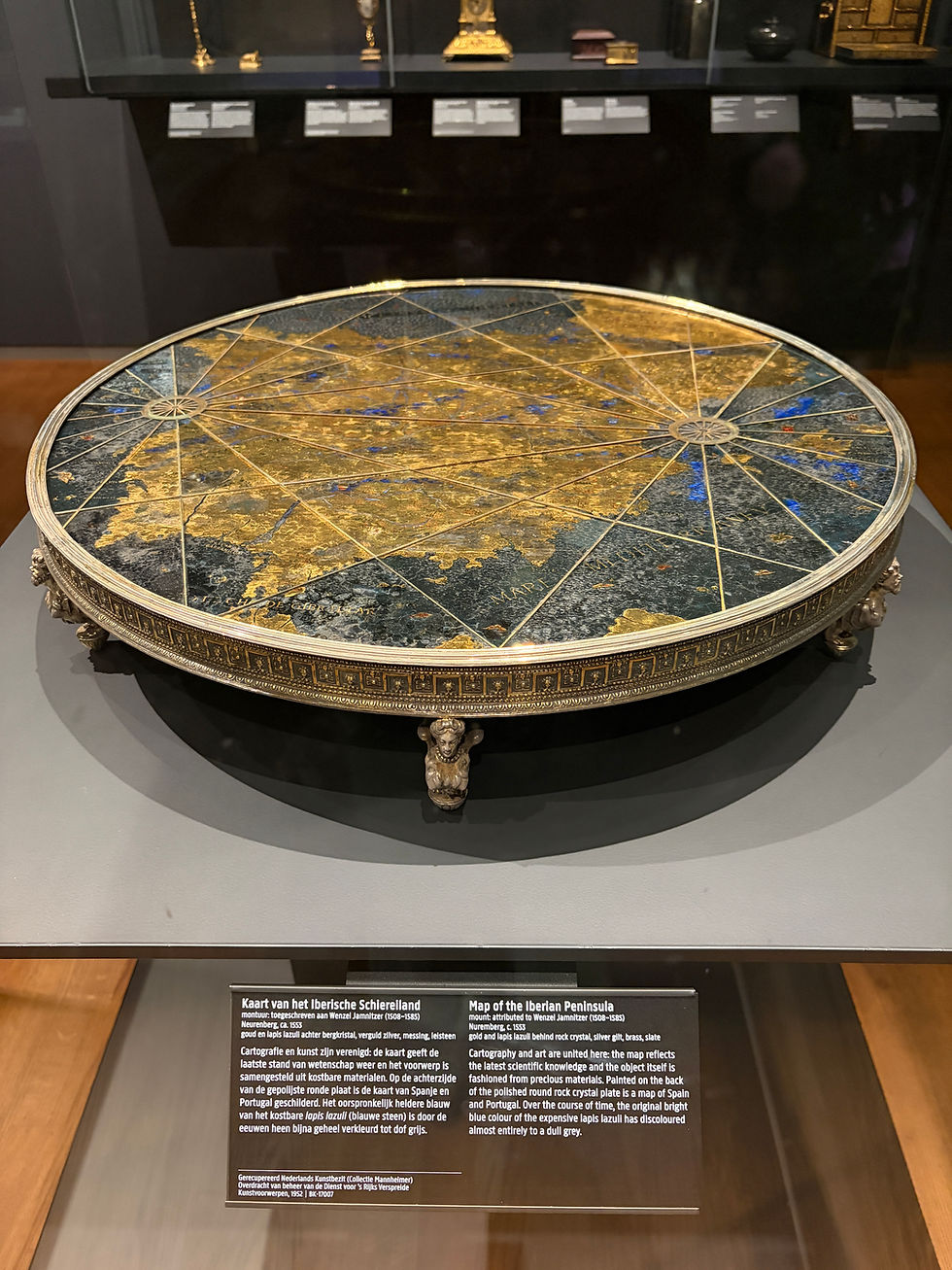
These are ancient Greek and South Italian black-glazed vessels, probably used for cosmetics, scented oils, medicines, or other small valuable substances.
The vessel marked 35 is a pyxis, a small lidded container or box. It was made in Athens around the 3rd to 2nd century BCE and may have held ointments, powders, jewelry, or personal-care items.
The vessels numbered 36–39 are gutti, small pouring bottles made in Apulia, southern Italy, around the 4th to 3rd century BCE. Their narrow spouts allowed liquids such as oil, perfume, or medicinal preparations to be dispensed slowly, almost drop by drop. Some are decorated with molded medallions showing figures such as Heracles, Eros riding a dolphin, a Gorgon face, and a human profile.
The glossy black surface came from a carefully controlled ceramic firing process, not from modern paint or varnish. These are especially relevant because vessels like these could have stored plant-based oils, fragrances, cosmetics, and medicinal compounds.

These are Roman silver vessels and utensils, mostly from Roman Gaul and dating roughly from the 1st to early 3rd centuries CE. They belonged to the world of formal dining, wine service, ritual offerings, and elite household display. This display shows how herbs, spices, wine, infused oils, and sauces would have been presented and consumed in wealthy Roman households. These were not storage containers like the black ceramic vessels in the earlier case. They were part of the serving dishes that turned food and drink into ceremony, hospitality, and a visible sign of status.


The beautifully engraved maps trace the expanding trade networks that connected Europe with Asia, Africa, and the Americas. Botanical illustrations reveal how explorers and naturalists documented newly discovered plants with extraordinary precision centuries before photography existed. Coins and currency illustrate how commerce financed exploration and how plants, empires, wealth, and trade became inseparable.
The library's collections remind me that exploration did not end when a ship returned home. Plants had to be identified, classified, illustrated, published, and shared before they could influence medicine, agriculture, horticulture, cuisine, or education.
This makes the BnF especially meaningful to my fellowship. I am not simply following where spices traveled. I am following what happened to the knowledge surrounding them. A pepper, herb, seed, or medicinal plant could move from a field to a ship, from a market to a pharmacy, from a botanical garden to a scientific illustration, and finally into a book, map, or archive.Together, the Latin Quarter, the Seine, the Pharmacy Museum and gardens, and the BnF demonstrate that Paris was far more than a destination for imported plants. It was a city where those plants became medicine, science, literature, art, and knowledge.
Connecting the Two Cities
Amsterdam and Paris tell two chapters of the same story. Amsterdam reveals how exploration, commerce, and maritime trade moved the world's botanical treasures across oceans. Paris demonstrates what happened after those treasures arrived. Here they were studied, preserved, illustrated, published, and transformed into knowledge that influenced science, medicine, agriculture, and culture.
My fellowship taught me that agriculture extends far beyond fields and farms. Plants shaped exploration, economics, medicine, literature, architecture, education, and even national identity. Every spice jar tells a story of geography. Every botanical illustration preserves a moment of discovery. Every museum and library safeguards centuries of agricultural knowledge.
Bringing the Journey Home
This fellowship is already reshaping my classroom at Daphne High School.
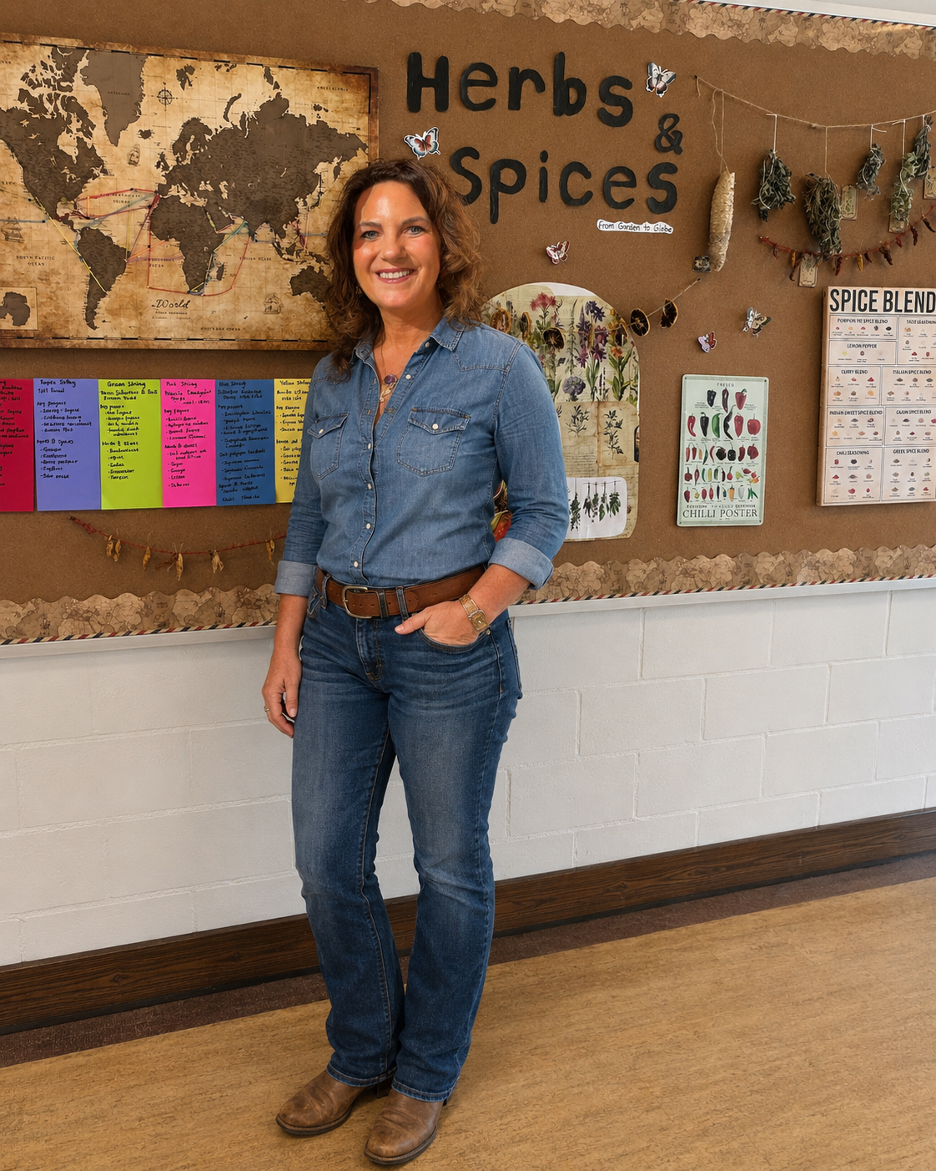
Rather than teaching herbs and spices simply as crops, my students will explore them as travelers through history. They will investigate where plants originated, how trade routes carried them across continents, and how different cultures adapted them into food, medicine, and daily life. As we study Alabama's native plants alongside globally traded species, students will discover that agriculture is both deeply local and profoundly global.
Our greenhouse, native plant gardens, herb beds, pepper collections, and horticultural therapy projects will become living connections to the same global story that unfolds in Amsterdam and Paris.
Barcelona: Where the Mediterranean Met the World

Saffron: Probably originated in the eastern Mediterranean or Southwest Asia; long cultivated in Spain
Paprika and chili peppers: Mexico, Central America, and South America
Rosemary and thyme: Mediterranean region
Parsley: Mediterranean region
Garlic: Central and western Asia
For centuries, Barcelona served as one of Europe's great commercial ports, linking Spain with Italy, North Africa, the eastern Mediterranean, and beyond. Merchants unloaded silk, spices, sugar, dyes, and precious goods from the East while exporting wool, wine, olive oil, textiles, ceramics, and metalwork throughout the Mediterranean. Walking through Barcelona's Gothic Quarter, I found myself tracing the same streets where merchants, sailors, and craftsmen once built the commercial networks that would eventually expand across the globe.

One of the highlights of my visit was the Barcelona History Museum (MUHBA). Rather than simply displaying artifacts, the museum preserves the actual Roman city of Barcino beneath the modern streets. Walking through ancient wineries, fish-salting facilities, workshops, warehouses, and commercial buildings revealed that Barcelona's identity as a center of trade stretches back nearly two thousand years.

These excavations illustrate how agriculture, food processing, manufacturing, and commerce were already interconnected during the Roman Empire. Olive oil, wine, salted fish, and textiles moved through these markets much as agricultural commodities move through modern supply chains today.


Equally significant was standing at the Royal Palace (Palau Reial Major), traditionally recognized as the place where Christopher Columbus returned after his first voyage in 1493 to present his discoveries to King Ferdinand and Queen Isabella. It was here that Europe first encountered many of the plants and products that would transform agriculture forever. Although Columbus returned with gold, tropical birds, and Indigenous people, the true legacy of these voyages would become the movement of crops. Peppers, tomatoes, potatoes, beans, maize, cacao, vanilla, and many other American plants would soon spread across Europe, while wheat, citrus, onions, horses, and livestock traveled in the opposite direction. Standing in this historic space, I could almost imagine the excitement and uncertainty surrounding what would become known as the Columbian Exchange, one of the most important agricultural events in human history.


A walk through the Port of Barcelona reinforced the city's importance as a maritime gateway. Long before Spain turned its attention toward the Atlantic, Barcelona's harbor connected Europe with North Africa and the eastern Mediterranean. Merchant vessels transported wool, olive oil, wine, ceramics, coral, iron, spices, silk, and sugar through these waters. The city developed sophisticated systems of merchant banking, maritime insurance, and commercial law that helped shape international trade for centuries. While Amsterdam would later dominate global spice commerce, Barcelona laid much of the commercial foundation upon which later European exploration was built.

One of the most enjoyable stops was the Chocolate Museum (Museu de la Xocolata), which tells the remarkable story of cacao's journey from the civilizations of Mesoamerica to the tables of Europe. Originally consumed by the Maya and Aztec as a bitter ceremonial drink, chocolate was transformed after its arrival in Spain with the addition of sugar, cinnamon, vanilla, and other imported spices. I was reminded that chocolate itself represents the blending of multiple continents. Cacao originated in the Americas, vanilla in Mexico, cinnamon in Asia, and sugar spread through Mediterranean and Atlantic trade. Every cup of chocolate tells a story of exploration, commerce, and agricultural exchange. Here we learned also about the art of making Nougat.


Our paella cooking experience offered another lesson in history through food. Although often considered Spain's signature dish, paella reflects centuries of cultural exchange. Rice was introduced during the Islamic period, saffron traveled from Southwest Asia through medieval trade routes, olive oil and herbs have deep Mediterranean roots, while tomatoes and peppers arrived only after contact with the Americas. As we prepared the dish using items purchased at the local market, I realized that each ingredient represented a different chapter in the history of agriculture. Paella is more than a recipe; it is an edible timeline of trade and cultural exchange.


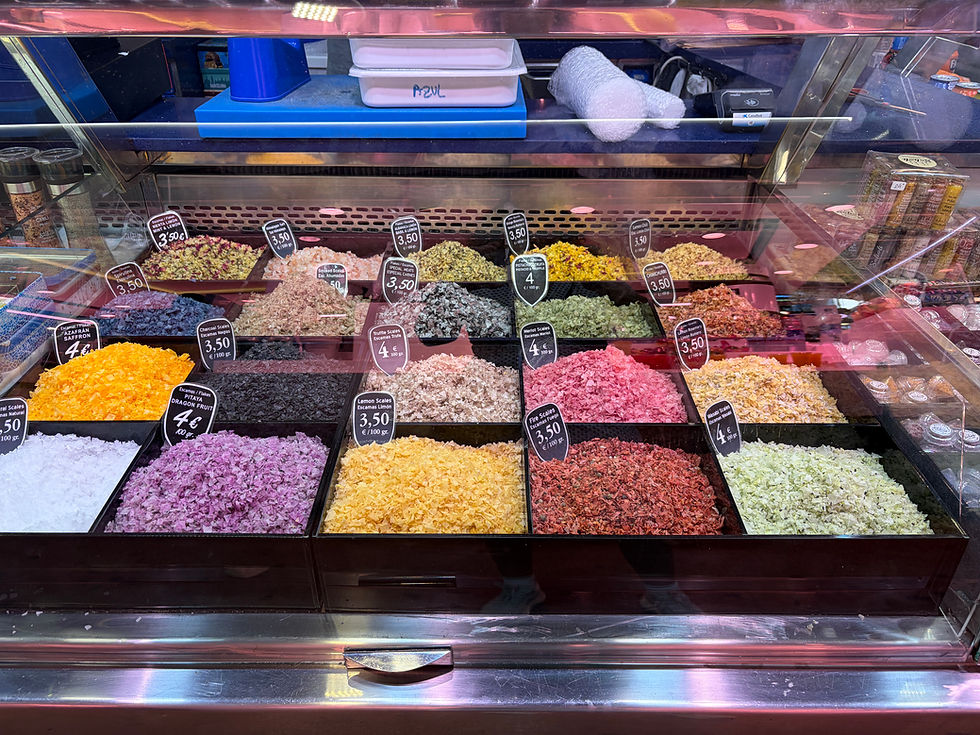
One of my favorite experiences was exploring La Boqueria Market which we went to when collecting our paella items and then again the next day. Here, the history of agriculture comes alive in vibrant displays of fresh produce, herbs, spices, seafood, cured meats, cheeses, and olive oils. As someone who spent last summer studying chili peppers in Peru and Bolivia, I was naturally drawn to the incredible variety of peppers on display. Sweet bell peppers, long frying peppers, smoked paprika, dried ñora peppers, and the famous Padrón peppers all illustrate how completely Capsicum species from the Americas have become woven into Spanish agriculture and cuisine. Walking through the market also introduced me to regional products including olives, almonds, citrus fruits, tomatoes, garlic, onions, saffron, rosemary, thyme, and locally produced olive oils. Together, these ingredients demonstrate the blending of Old World and New World agriculture that defines modern Spanish cooking.




Barcelona became the point where many threads of this fellowship converged. Amsterdam introduced the wealth generated through the spice trade, and Paris explored the scientific study of plants. Barcelona demonstrated how those same plants entered ports, markets, kitchens, and daily life. From the Roman streets beneath the Barcelona History Museum to the Royal Palace where Columbus reported his discoveries, from the bustling harbor to La Boqueria and the Chocolate Museum, the city illustrates that trade has always been about more than the movement of goods. It is the movement of plants, people, ideas, technologies, and cultures. For me, Barcelona served as the perfect transition from the medieval Mediterranean world to the Age of Exploration, setting the stage for the next chapter of my journey in Granada, where Islamic science, horticulture, and engineering reached one of their greatest expressions.
Granada: Where Paradise Was Cultivated

Mint: Mediterranean region and western Asia
Cumin: Eastern Mediterranean and Southwest Asia
Coriander: Mediterranean region and western Asia
Saffron: Eastern Mediterranean or Southwest Asia
Cinnamon: Sri Lanka
Cloves: Maluku Islands
Tea: China and adjoining areas of East and Southeast Asia
If Amsterdam revealed how spices generated wealth, Paris demonstrated how plants advanced science and medicine, and Barcelona illustrated the expansion of global commerce, Granada showed me where many of those ideas first flourished in Europe.
For nearly eight centuries, much of the Iberian Peninsula was governed by Muslim rulers who transformed southern Spain through innovations in agriculture, engineering, medicine, architecture, and scholarship. Their influence reached its pinnacle in Granada, the final kingdom of Al-Andalus and home to one of the world's greatest architectural masterpieces: the Alhambra.
More than a palace, the Alhambra is a living expression of a civilization that believed beauty, knowledge, water, and nature were inseparable.
One of the greatest privileges of this fellowship was staying inside the walls of the Alhambra itself at the Parador de Granada.


Spain's Paradores are unlike ordinary hotels. They are historic castles, monasteries, convents, palaces, and fortresses that have been carefully restored so visitors can experience history rather than simply observe it.

The Parador occupies the former Convent of San Francisco, built shortly after the Christian conquest on the site of a former Nasrid palace. Ferdinand and Isabella commissioned the convent, and for several years their remains rested there before being moved to Granada's Royal Chapel.
As evening settled over the Alhambra and the day visitors departed, the fortress became remarkably quiet. Walking through the monastery gardens, hearing fountains echo through ancient courtyards, and watching the last light settle on the palace walls created an atmosphere unlike anywhere else I visited during the fellowship. It felt less like staying at a hotel and more like becoming part of the history itself.
Walking Through the Alhambra

The next morning I joined a tour and we entered the Alhambra as the gates opened.
Although often described simply as a palace, the Alhambra was actually a complete royal city. Behind its fortified walls were palaces, government buildings, military barracks, workshops, baths, mosques, gardens, orchards, reservoirs, and homes for nobles and servants. Every feature reflected careful planning and extraordinary craftsmanship.


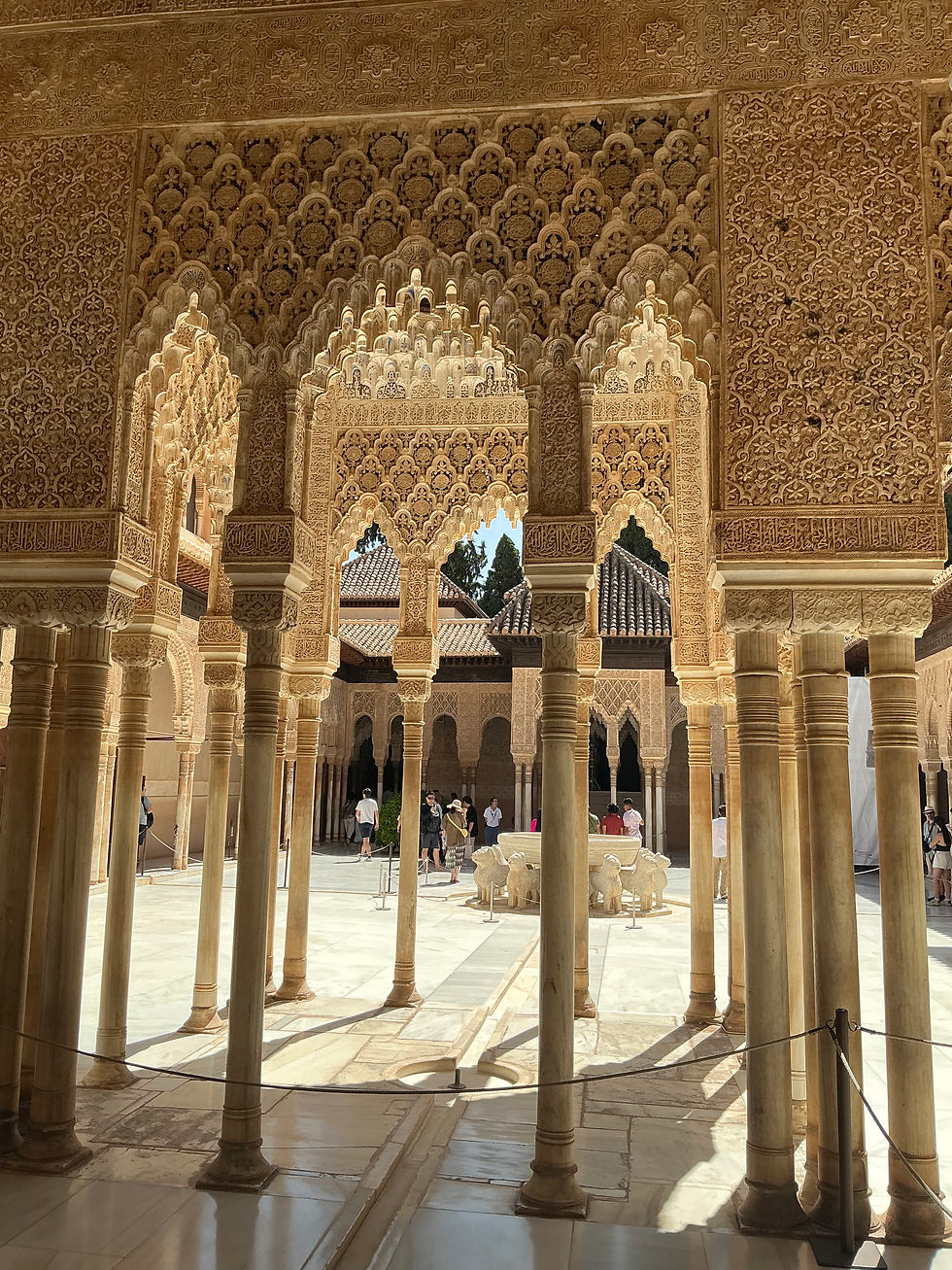


As we walked through the Mexuar, the Palace of Comares, and finally into the Court of the Lions, I was struck by how differently wealth was expressed here. Unlike many European palaces filled with gold, marble, and elaborate furniture, the luxury of the Nasrid rulers was found in geometry, poetry, water, light, and craftsmanship.
Arabic calligraphy covers nearly every wall, praising God and reminding rulers that earthly power is temporary. Delicate stucco carvings, colorful ceramic tiles, carved cedar ceilings, and lattice windows create an ever-changing play of light that makes every room feel alive.
Water: The Greatest Luxury
More than anything else, the Alhambra taught me about water.
In the dry climate of southern Spain, water represented life itself. Engineers diverted snowmelt from the Sierra Nevada through miles of canals into reservoirs, fountains, reflecting pools, baths, orchards, and gardens without the aid of pumps or electricity.
The famous Court of the Myrtles reflects the palace in perfectly still water, while the Court of the Lions distributes flowing water through an ingenious hydraulic system that still functions today.


As an agriculture instructor, I found these irrigation systems just as impressive as the architecture. They demonstrate principles of gravity-fed irrigation, water conservation, and landscape design that remain relevant to sustainable agriculture today.
The Alhambra is as much an engineering achievement as it is an architectural one.
Gardens as Classrooms
The Generalife gardens became one of my favorite places in Spain.
Today they are celebrated for their beauty, but they were originally designed as productive landscapes that combined food production, medicinal plants, fragrant flowers, fruit trees, shade, and flowing water into a single harmonious system.
Walking through terraces planted with roses, lavender, rosemary, myrtle, jasmine, citrus, figs, and pomegranates, I was reminded that medieval Islamic gardens blurred the distinction between ornamental and practical horticulture.


A garden was expected to nourish the body, delight the senses, provide medicine, attract pollinators, and inspire contemplation.
The abundance of flowering plants also supported bees, butterflies, and other pollinators, creating biodiverse landscapes centuries before ecology became a scientific discipline.
Many of the same principles promoted today through sustainable landscape design, efficient irrigation, biodiversity, and edible gardens were already being practiced here over six hundred years ago.
The Islamic Agricultural Revolution


Throughout my fellowship I followed the movement of plants, but nowhere was their story more evident than in Granada. Islamic scholars and merchants connected agricultural knowledge stretching from Persia and India to North Africa and Spain. They introduced or expanded the cultivation of crops such as citrus, rice, sugarcane, spinach, eggplant, almonds, saffron, cotton, pomegranates, and numerous herbs. Equally important was the exchange of botanical knowledge. Physicians and botanists carefully documented the medicinal uses of rosemary, sage, thyme, lavender, mint, fennel, coriander, cumin, anise, roses, and countless other plants. Their writings would later influence European medicine for centuries. Walking through the gardens of the Alhambra, I found many of these same plants still growing today.
The Hammam: Wellness Through Water and Plants
After spending the day exploring the Alhambra, we visited Hammam Al Ándalus, an experience that brought another aspect of Islamic culture to life.
A hammam is far more than a public bath. Adapted from Roman bathing traditions, it became an important institution throughout the Islamic world where physical cleansing, relaxation, social gathering, and spiritual preparation were woven together.
Moving slowly between cool, warm, and hot pools while listening to flowing water echoed traditions that have existed for more than a thousand years.

Throughout the experience I sampled a variety of herbal teas prepared from plants long valued throughout the Islamic world. Fresh mint refreshed the palate and aided digestion. Chamomile promoted relaxation. Lemon verbena and lemon balm were served for their calming qualities. Sage and thyme reflected their long history in traditional medicine, while fragrant rose and green tea completed the experience.

Many of these herbs appear repeatedly in the writings of medieval physicians such as Avicenna, Al-Zahrawi, and Ibn al-Baytar, whose botanical knowledge profoundly influenced both Islamic and European medicine. As someone who teaches horticulture, I appreciated that these plants were not presented as museum artifacts. They remain part of everyday life.
A Garden of Fragrance
Before leaving Granada, I visited one of the city's perfume gardens, where another dimension of the fellowship came into focus.
The gardens celebrated aromatic plants including damask roses, lavender, rosemary, jasmine, orange blossom, myrtle, and countless Mediterranean herbs. Medieval Islamic scholars perfected steam distillation techniques that allowed essential oils and floral waters to be extracted for perfumes, cosmetics, medicine, and culinary use.
Walking among these fragrant gardens, I understood that scent was intentionally woven into the landscape. Fragrance became another language through which gardens expressed beauty, hospitality, and healing.

Even today, Granada smells of orange blossoms in spring, rosemary warmed by the sun, jasmine climbing ancient walls, and herbs growing beside fountains.
Carmona: Sleeping Inside the Story
Bitter orange: South and Southeast Asia, carried west through the Islamic world
Rosemary, oregano, thyme, and bay: Mediterranean region
Chili peppers and paprika: The Americas
Cacao: Tropical Central and South America
Vanilla: Mexico and Central America
Black pepper and cinnamon: South Asia and Sri Lanka

Perched above the Andalusian plains, the town of Carmona brought together Roman roads, Islamic walls, Christian churches, convents, farms, and royal fortifications. At its eastern edge stood the place that shaped my visit most: the Parador de Carmona, built on the site of the Alcázar del Rey Don Pedro.
This was not simply a hotel near history. It was a place where history still formed the walls, courtyards, views, and atmosphere around me.


A Town Built Along a Ridge
A historic map displayed inside the Parador showed Carmona stretching from the Roman necropolis in the west to the royal Alcázar in the east. Between them stood the Puerta de Sevilla, Plaza de San Fernando, Santa María, Santa Clara, Santiago, and the Puerta de Córdoba. The map revealed that Carmona was not a collection of separate monuments. It was one long historical route shaped by defense, trade, agriculture, and movement. The Parador sat at the end of this route, but it also felt like its anchor. From there, the entire town seemed to unfold below and behind it. Another image inside the Parador showed an 1886 plan of the Alcázar. Thick walls, towers, courtyards, a barbican, gates, and a large parade ground revealed the scale of the original fortress.

The modern Parador occupies only part of that complex, yet the plan helped me imagine what once stood there. Hallways, terraces, and guest rooms began to feel connected to a much older royal and military landscape.
The Land Below the Parador
From the Parador terrace, the Vega de Carmona spread out in a wide patchwork of fields, roads, orchards, and distant farms.

The view explained why this hill mattered for so many centuries. It offered both protection and control over the surrounding agricultural land and travel routes.
It also reinforced one of the central ideas of my fellowship: palaces and cities could exist only because farmers, water systems, storage spaces, and trade networks supported them.
A Link to Seville
The Alcázar de Carmona was associated with Pedro I, the same king connected to the magnificent Mudéjar palace inside the Real Alcázar of Seville.
That connection made Carmona feel like an extension of my day in Seville. Both sites reflected the blending of Islamic design and Christian royal power. Horseshoe arches, courtyards, fountains, tiles, and enclosed gardens carried the influence of al-Andalus into later centuries.

More Than a Place to Stay
The Parador became more than lodging. It gave me a place from which to understand Carmona.
From its terrace, I saw the agricultural plain. From its maps, I traced the town’s history. From its floor plan, I found wells, silos, and cisterns. From its architecture, I saw the continuing influence of Islamic Spain.

Carmona reminded me that history is sometimes found not in a grand museum display, but in an old map hanging on a wall, the outline of a vanished courtyard, or a terrace overlooking fields that have supported a town for centuries.
The Parador stood at the center of it all, becoming not simply where I stayed, but an integral part of the journey.
Seville: Where Empires, Faith, and Gardens Changed the World
Today felt less like visiting a city and more like walking through the pages of history. Every street, courtyard, and cathedral seemed to tell a story about exploration, cultural exchange, and the plants that transformed civilizations. As someone studying horticulture and the Columbian Exchange, I quickly realized that Seville isn't just a beautiful destination. It was the crossroads where two worlds met.
Plaza De Espana

Seville’s Plaza de España, created for the 1929 Ibero-American Exposition, celebrated Spain’s historic connections with Latin America, while its tiled alcoves represented the provinces of Spain. Four were especially meaningful to my studies: Huelva, linked to Palos, La Rábida, and Columbus’s departure; Seville, the administrative center of trade with the Americas; Cádiz, which later became Spain’s principal Atlantic trading port; and Granada, whose Islamic gardens, irrigation systems, herbs, and spices reflected the agricultural knowledge that shaped southern Spain before the Columbian Exchange.


The Cathedral
Stepping inside the Seville Cathedral, I was immediately struck by its sheer scale. Built on the site of a former mosque, the cathedral symbolizes centuries of cultural transformation while preserving pieces of its Islamic past, most notably the Giralda, once a minaret and now the cathedral's bell tower. One of the most meaningful moments was standing before the tomb of Christopher Columbus. Four heralds representing the medieval kingdoms of Castile, León, Aragon, and Navarre carry his tomb high above the floor. Whether one views Columbus as an explorer, a visionary, or a deeply complicated historical figure, there is no denying that his voyages forever changed the movement of plants, food, medicine, and cultures around the globe.


The Royal Alcázar: One Thousand Years in One Palace
Walking into the Real Alcázar felt like stepping into a timeline rather than a palace.
Unlike many royal residences that were rebuilt from scratch, the Alcázar grew layer upon layer. Roman foundations became an Islamic fortress. Muslim kings expanded it into a palace of gardens and fountains. Christian monarchs conquered the city but preserved the beauty they found, adding Gothic halls beside Islamic courtyards. Renaissance kings later transformed the gardens while keeping the original irrigation systems.
The result is one of the most remarkable examples of cultural continuity anywhere in Europe.

The Courtyard of the Maidens
Perhaps nowhere better represents the blending of cultures than the Courtyard of the Maidens. Long reflecting pools mirror elegant arches.
Water flows quietly through carefully engineered channels.
Symmetry creates peace.
The courtyard reflects Islamic ideals of paradise gardens while serving as the heart of a Christian royal palace.
It reminded me that beauty often survives political change.

Gardens That Tell the Story of Agriculture
For me, the gardens were every bit as fascinating as the palace itself.
Walking among citrus trees, pomegranates, palms, rosemary, jasmine, and myrtle, I couldn't help imagining what these gardens looked like before 1492.
There were oranges.
There were herbs.
There were roses.
But there were no peppers.
No tomatoes.
No potatoes.
Those plants had yet to cross the Atlantic. Every garden became a living reminder that landscapes evolve just as civilizations do.


Water: The Invisible Masterpiece
Perhaps the greatest engineering achievement of the Alcázar isn't found in its architecture.
It's found beneath your feet.
The Islamic engineers who designed these gardens understood that water was precious. Their canals, fountains, pools, and irrigation systems cooled the air, nourished orchards, and transformed a hot climate into a lush paradise.
As a horticulturist, I found myself paying almost as much attention to the water as I did the plants.


The House of Trade
One of the most significant discoveries for my fellowship was learning about the Casa de Contratación, or House of Trade. This administrative office managed Spain's relationship with the New World. Maps were produced here. Captains trained here. Cargo was documented here. Records of peppers, cacao, medicinal plants, silver, and countless other products flowing between continents all passed through these rooms.
Standing here made the Columbian Exchange feel immediate rather than distant history.

The Final Stop: Where the Voyage Began
The final stop of the journey brought me to La Rábida Monastery and the nearby Muelle de las Carabelas, where full-size replicas of the Niña, Pinta, and Santa María recall Columbus’s 1492 voyage.

At the monastery, Columbus found support as he developed his plans and sought backing for the expedition. A short distance away, standing beside the ships made the story feel far more real. They seemed surprisingly small for vessels that crossed an ocean and changed the movement of people, plants, animals, and ideas forever.

It was a fitting final stop. After tracing trade routes, gardens, palaces, ports, and agricultural exchange across Europe, I ended at the place where one of history’s most consequential voyages began.


Comments