


Aztec Market Simulation


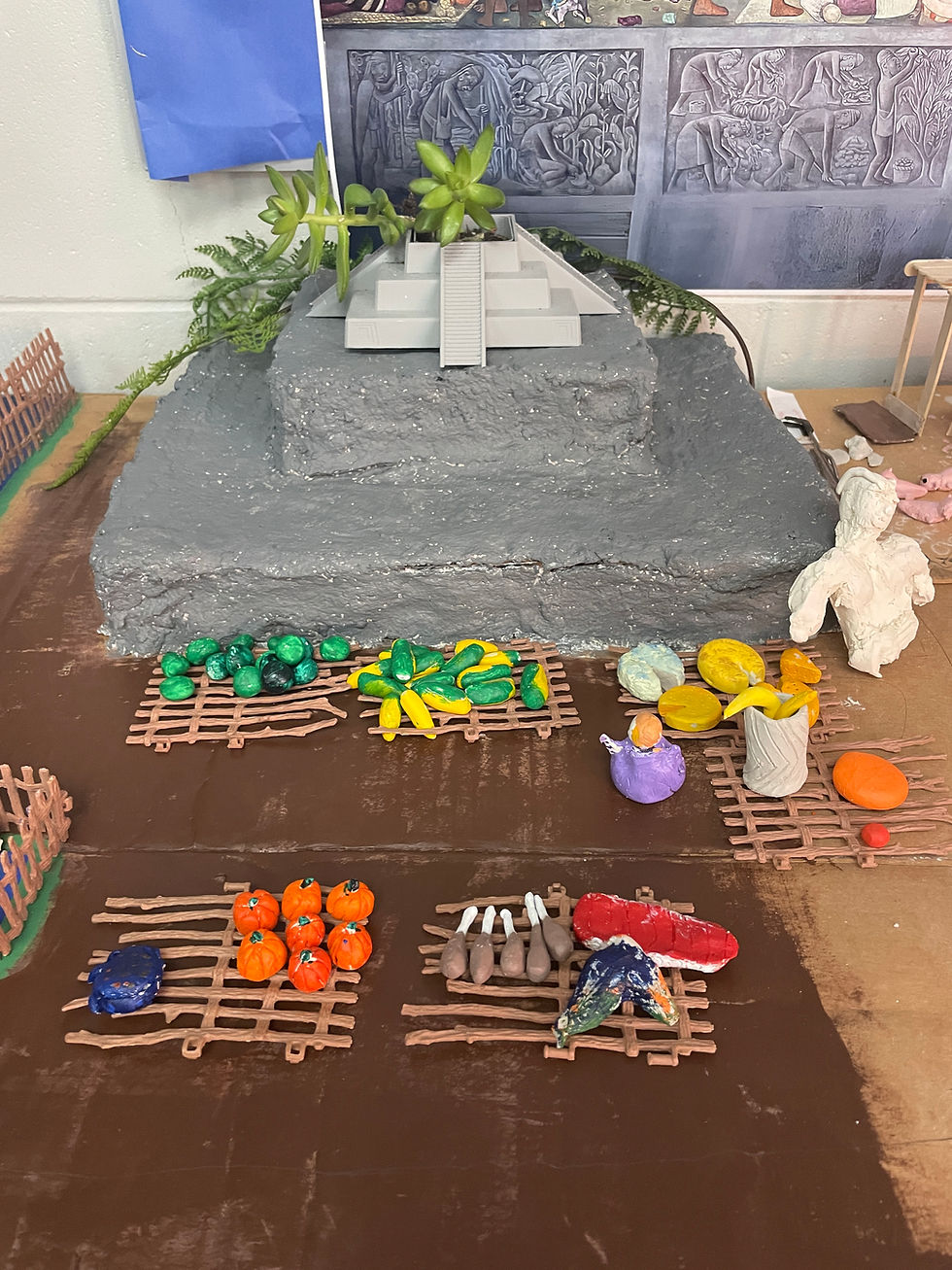
Below is a hands-on classroom simulation game where students create clay replicas of Aztec or Pre-Columbian market items and then participate in a marketplace using either bartering or chili peppers as currency. This game can be adapted for middle or high school classes focusing on Mesoamerican history, economics, or art.
Overview
Grade Level: Middle/High SchoolSubjects: Social Studies (Mesoamerican History), Economics, ArtDuration: 1–2 class periods (plus any preparation time for making clay items)
Objectives
Cultural/Historical Understanding
Students will learn about Aztec and other Pre-Columbian marketplaces, items traded, and forms of exchange (barter and commodity currency).
Artistic Expression
Students will sculpt clay items representative of Aztec or Pre-Columbian goods, practicing basic clay modeling techniques.
Economic Principles
Students will experience bartering and commodity-based currency (chili peppers), observing supply, demand, and negotiation in a simulated market environment.
Collaboration & Communication
Students will refine communication skills as they negotiate trades, collaborate with peers, and adapt to changing market conditions.
Materials Needed
Modeling Clay
Air-dry clay or oven-bake clay, enough for each student (or small groups) to create 1–2 items.
Reference Images/Handouts
Pictures or descriptions of typical Aztec/Pre-Columbian goods such as pottery, woven textiles, obsidian tools, cacao beans, jewelry, jade ornaments, maize, peppers, etc.
Chili Peppers (Currency)
Dried chili peppers (or paper tokens/paper chili pepper cutouts if using real peppers is not feasible).
Enough “currency” so that each student/group has a manageable number (e.g., 5–10 peppers per participant).
Optional Market Props
Small tables or desk clusters for “market stalls.”
Labels/signs for each stall (e.g., “Maize Merchant,” “Textile Weaver,” “Potter,” etc.).
Rubric or Reflection Prompts
For assessing student participation, understanding of economic concepts, and creativity.
Game Setup and Steps
Step 1: Assigning Market Items
Random or Thematic Assignment
Before the simulation day, give each student (or small group) a specific Aztec or Pre-Columbian item to research and create. Examples:
Maize (corn)
Chili peppers
Cacao beans/chocolate
Woven cloth/textiles
Obsidian tools or blades
Clay pottery
Jade or turquoise jewelry (modeled in clay with green/blue paint)
Encourage variety so the class has a diverse marketplace.
Research Component (optional homework or class research)
Have students learn key facts about their assigned item:
How it was produced or obtained.
Its role in Aztec society (food staple, luxury good, everyday utensil, etc.).
Its relative value or rarity in Aztec marketplaces.
Step 2: Crafting the Clay Items
Art Session
Provide air-dry or oven-bake clay.
Show basic techniques (rolling, pinching, coiling) as needed.
Encourage students to shape their item to approximate size/shape. For example:
A miniature clay ear of maize, small clay bowl or pot, tiny obsidian “tools,” etc.
Let the items dry/solidify according to the clay’s instructions.
Painting/Decorating (optional)
Once dry, students can paint their items to resemble their historical counterparts.
Add minimal details or symbols that connect to Aztec design if time allows.
Step 3: Setting Up the Marketplace
Marketplace Layout
Rearrange desks or set up “market stalls” around the classroom.
Provide a sign or label for each stall identifying the good being sold (“Pottery Stall,” “Woven Textiles Stall,” etc.).
Distribution of Chili Pepper Currency
Give each student or group a set number of chili peppers (or pepper tokens).
Emphasize that these peppers function as currency, but bartering is also allowed if both parties agree.
Rules for Trading
Each stall sets its own initial “prices” in chili peppers. For example, a piece of pottery might cost 3 chili peppers; a woven cloth might cost 5.
Negotiation is allowed—students can haggle, trade goods for goods, or combine goods and peppers to find acceptable deals.
Encourage realistic scarcity or abundance: if multiple students are selling the same item, the price may drop; if only one student sells a rare item, the price may rise.
Step 4: The Simulation Game
Open the Market
Let students freely walk around, observe items for sale, ask questions, and initiate trades.
Negotiations & Transactions
Students use chili peppers to purchase clay goods or propose bartering if they have an item another stall desires.
They record each transaction briefly (e.g., “Traded 2 peppers for a clay pot”) on a simple log sheet or in a notebook to track activity.
Market Fluctuations (Optional Twist)
Mid-simulation, the teacher can announce an “event” to reflect real-world economic changes or environmental factors. For example:
Drought or Crop Failure: Fewer chili peppers are available, making them more valuable (teachers temporarily “collect” peppers from some students to simulate loss).
Bountiful Harvest: A fresh batch of peppers enters circulation, potentially causing inflation (teacher distributes extra peppers).
Demand Spike: Announce that obsidian tools are now in high demand for a new building project, driving up the price.
Closing the Market
After a set amount of time (15–30 minutes), close the market.
Have students tally final possessions: How many peppers remain? How many goods did they acquire?
Step 5: Debrief and Reflection
Group or Whole-Class Discussion
Prompt questions:
“Which items were most in-demand and why?”
“Did anyone choose to barter instead of spending peppers? How did that work out?”
“How did your strategies change if peppers became scarce (or abundant)?”
“What parallels can you draw between this simulation and real-life markets—both historic and modern?”
Written Reflection
Students can write a short paragraph or exit ticket reflecting on:
The challenges and advantages of using a commodity as currency.
How the supply or rarity of items affected their prices.
Connections to Aztec history and trade practices.
Assessment
You may use a rubric that evaluates:
Historical Accuracy of the clay item.
Engagement & Participation in trading.
Economic Understanding (ability to negotiate, observe supply/demand).
Creativity & Craftsmanship of the clay project.
Extensions and Variations
Research Presentations
Students give a short presentation on their item’s historical context, how it was produced, and why it was valuable in Aztec or other Pre-Columbian markets.
Mathematical Integration
Have students calculate the total “value” of goods traded or track how prices changed over time, tying in supply-and-demand curves.
Comparative Study
Compare the Aztec system of bartering/commodity currency with other historical or modern-day economies where alternative currencies have been used (e.g., shell money, salt, digital currencies).
Cultural Connections
Invite students to explore how chili peppers continue to play a significant cultural and economic role in many global cuisines and markets today.
Conclusion
This simulation game immerses students in the commercial world of the Aztecs (and other Pre-Columbian civilizations) through a creative and interactive classroom marketplace. By sculpting clay goods and trading them using chili peppers or direct barter, students gain a deeper appreciation of the dynamics of supply, demand, and commodity-based currency systems—while also honing artistic and collaborative skills.





Comments