


🌶 Packing Peppers & Prophecies: A Journey to Lima Begins
- The Agricoutourist

- Jun 15, 2025
- 4 min read
Updated: Jul 20, 2025
Before you can find chili pepper vessels in ancient museums, you have to survive packing for three countries in one duffle bag—and in my case, survive a travel curling iron that took a solid chunk of my forehead hair. (Nothing a good hat and headband can’t hide.)
🌱 The Prep: Houseplants, Checklists, and Tarot
In the days leading up to this adventure, I:
Watered every houseplant and prepped my gardens at school and home.
Propagated over 100 plant cuttings to root in my absence.
Checked, rechecked, and ultimately ignored most of my packing checklist.
Packed my life into one very determined duffle bag.


One grounding ritual I brought with me: drawing an Adventure Tarot card each morning at breakfast—let the universe decide the theme for the day.June 14: 8 of Pentacles — mastery, learning, and long-term dedication. Fitting.

🏫 Why I’m Here: Peppers, People, and the Power of Place
This isn’t just travel—it’s a mission. I’m here to explore the ancient, spicy story of chili peppers and how they connect to human movement, trade, and culture. My goals:
Study ethnobotany—the co-evolution of people and peppers.
Visit museums that hold ancient ceramic vessels with chili pepper remnants.
Shop in markets in every city for peppers and other local agricultural products
Cook with legendary chefs, preserving and learning traditional methods.
Bring all of it back to enrich my high school agriculture program, especially around trade, migration, spices, and human geography.
Huge thanks to the National Education Association for supporting this dream and helping me grow as an educator.
🏙️ Lima’s Layers: History Beneath the Surface
Our first adventure? A walking food + architecture tour led by David—foodie, architecture student, and biophilic design enthusiast like myself!
🏛 Architectural Highlights: Layers of Influence
Lima’s architecture tells a story of migration, colonization, and cultural blending—each facade a clue.
San Martín Square: A place for free expression and spontaneous demonstration. You can start any protest—about politics, cats, or sandwich preferences—and people will either join or passionately argue. It’s participatory democracy at its most charming and chaotic.

Arab Influence: Much of Lima’s historic architecture, especially the intricate wooden balconies and inner courtyards, draws from Moorish (Arab-Andalusian) design—brought to Peru by the Spanish, who had absorbed it during centuries of Moorish rule in southern Spain.
You’ll see latticework, horse-shoe arches, and detailed carved wooden balconies. These features were not just decorative—they were practical, allowing women to observe the street while remaining unseen, and controlling light and airflow in a hot climate.
The influence reflects a deep layering of cultures: Arab design → Spanish colonialism → Peruvian adaptation.
Irish Gift: One of the government buildings was donated by the Irish community—an unusual but meaningful cross-cultural gesture.
Italian Museum Facades: Lima’s museums and civic buildings often include Renaissance-inspired symmetry and columns, especially in buildings like the Museo de Arte Italiano.
Hotel Bolívar: A glamorous holdout from Lima’s belle époque. Known for its crystal chandeliers, pisco sours, and celebrity guests—including Mick Jagger. It just turned 100, and the floral installations in the lobby were stunning.
🍽 Lima Through Its Flavors: The Street Food Tour
David took us on a wild, delicious loop of Lima’s culinary identity.
Stops & Highlights:
Domino: Ají amarillo (yellow chili) is in 70% of Peruvian food. We had Papa a la Huancaína—potatoes in golden chili sauce.


David with his super food - yellow aji Tamales


Santa Isabel Bodega: Tamales with rocoto pepper sauce. Spicy and unforgettable.

David editing my notes Street Vendor Sampler: Grilled beef hearts, beef stomach, and chicken. All in green rocoto sauce.


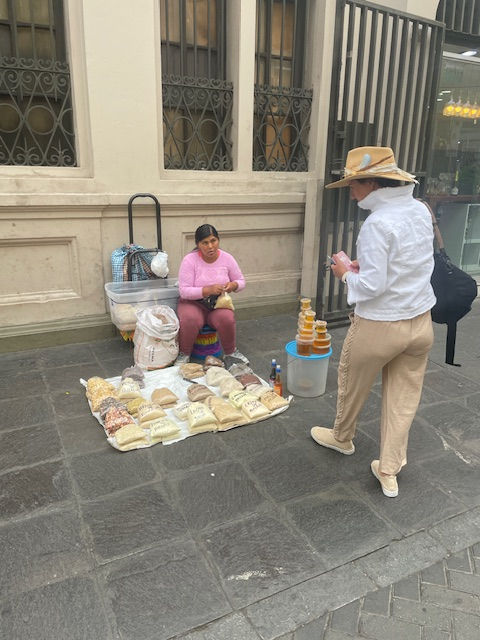
Downtown Market: Tasted Peruvian fruits—prickly pear, chirimoya, goldenberry, aguaymanto. Each with its own medicinal story.


Perfume Bar: Designed a personal scent. Mine smells like roasted peppers in the jungle. Puma bait!
Presidential Home Restaurant: Chilcano cocktail (pisco, lime, bitters, ginger ale) and tuna-avocado tiradito with cured Bonito and chimichurri. Found my new summer drink.


El Chinito: Pork belly sandwiches in a no-frills, all-local spot.

Churros cart: Filled with dulce de leche. Even dessert-averse me couldn’t resist. No pic too busy eating.



Corn Varieties of Peru

Peru has over 3000 varieties of potato

The third eye opens with Ayahuasca - not something I'll be doing on this trip.

Blending modern in with the old - and a touch of Biophilia
🛍 Lima’s Main Square: Ceremonies & Surprises
Plaza de Armas, Lima’s ceremonial heart, was overflowing with life.
We witnessed a wedding
Then, unexpectedly, the Parade of San Pedro rolled through: dancers, drums, feathers, and joy.
It reminded me that this plaza isn’t just a monument—it’s a living, breathing centerpiece of the city.


🌎 Museo Larco: Peppers, Plants & the Sacred Past
Later that evening, we visited the Museo Larco, a dream come true for anyone passionate about ethnobotany and ancient agriculture.
Surrounded by blooming bougainvillea, geraniums, and cacti, the museum grounds felt familiar yet enchanted.
Inside, we toured artifacts spanning 14,000 years of culture and 5,000 years of civilization—making Peru the home of the third oldest civilization in the world.


Plants we have at home are tremendous here!
Highlights:
Ceramic Vessels: Used for storytelling in place of writing, depicting daily life, agriculture, and spirituality. Many showed scenes involving chili peppers, used in rituals and in food.

One of my life bucket list things to see 

Agricultural Tools 
Ceramic Tools 
Sacred Animals: Art featured three realms of the universe—birds (heavens), felines (earth), and snakes (underworld).
Textiles: Woven with rich colors and sacred symbolism.


Needles for Textiles Abacuses: Early accounting systems used by ancient cultures.

Moche Cup of Blood: A ceremonial artifact uniting themes of warfare, sacrifice, and ritual.

Most Prized Item of the Collection 
Erotic Gallery: Demonstrated the link between fertility, agriculture, and spiritual balance in pre-Columbian beliefs. Pachamama (Mother Earth) was honored through depictions of union, fertility, and rain.
Public Storage Room: One of the only open-access museum storage areas in the world—45,000 artifacts not yet on display but available to see in cases.
A mummy and skulls deformed to separate the elite from other members of the community.


It was one of the most profound stops on our journey. The chili pepper's 9,000-year history was on full display.

Then at night we make friends
🔮 What’s Ahead
We’re just getting started. Coming up:
Visiting Arequipa, Cusco, Sacred Valley, Puno, and heading into Bolivia and Ecuador.
Exploring markets in every city.
Cooking with Peruvian and Andean chef legends.
Learning how the humble chili pepper connects entire civilizations.
Stay tuned for reflections, recipes, and rituals.
Grateful for the support of NEA Foundation and Legacy Grants



Comments